
How to Do Crop Farming in Minecraft? Complete Guide 2026
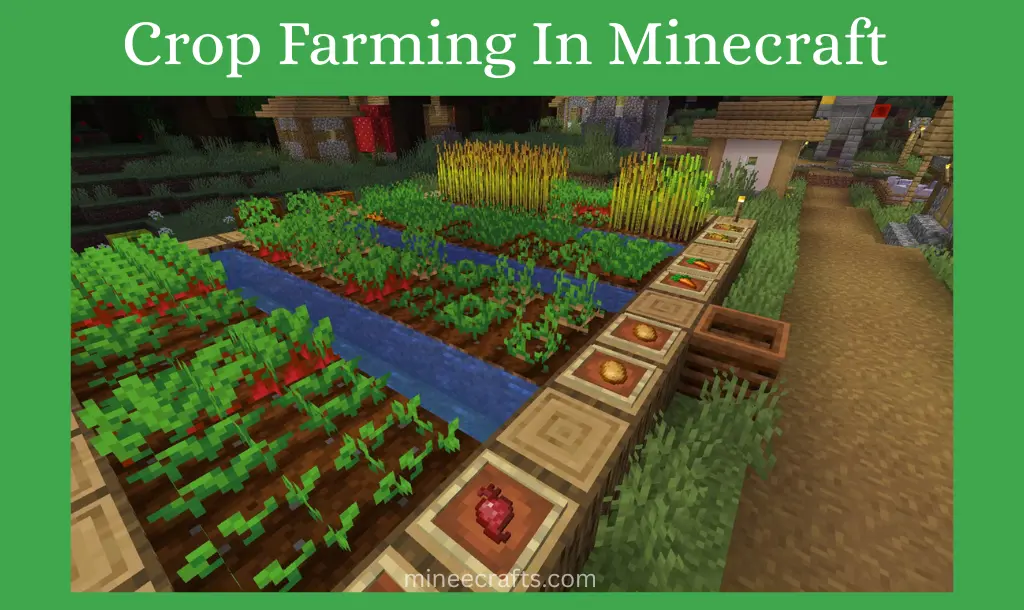
Farming is one of Minecraft’s most important survival features. Crop farming ensures a stable food supply, trading resources, and long-term sustainability, whether you’re a beginner starting your first survival world or an experienced player building massive automated farms.
This comprehensive guide will teach you how to do crop farming in Minecraft.
🌾 What Is Crop Farming in Minecraft?
Crop farming is the process of preparing farmland, planting seeds, growing crops, and harvesting food or materials. It is essential for survival, food supply, animal breeding, villager trading, and emerald farming. Without farming, survival mode becomes much harder.
🛠 Materials Needed for Crop Farming
Farmland
Farmland serves as a foundation for crop farming. We will grow crops on this land. Hoes can be used to transform green grass blocks into farms.
Water Source
Water is the basic need for crops to stay hydrated and grow effectively. So, keep the water source close to your farmland.
Hoe
The hoe is used to cultivate the land. (A hoe can be made of wood, stone, iron, gold, netherite, or even diamond).
Seeds
Crops in Minecraft require seeds to grow; seeds are the first stage of crop development. To obtain these crops, plant various crop seeds. Seeds undergo all of these processes before becoming useful resources known as crops.
Light
Light, like water, is a necessary component for crop growth. Choose farms that receive enough sunlight. If not, then you can set up torches.
Protection
Crop production requires protection from animals and mobs. Minecraft allows players to build fences to protect their farms.
🌱 All Crops You Can Farm in Minecraft
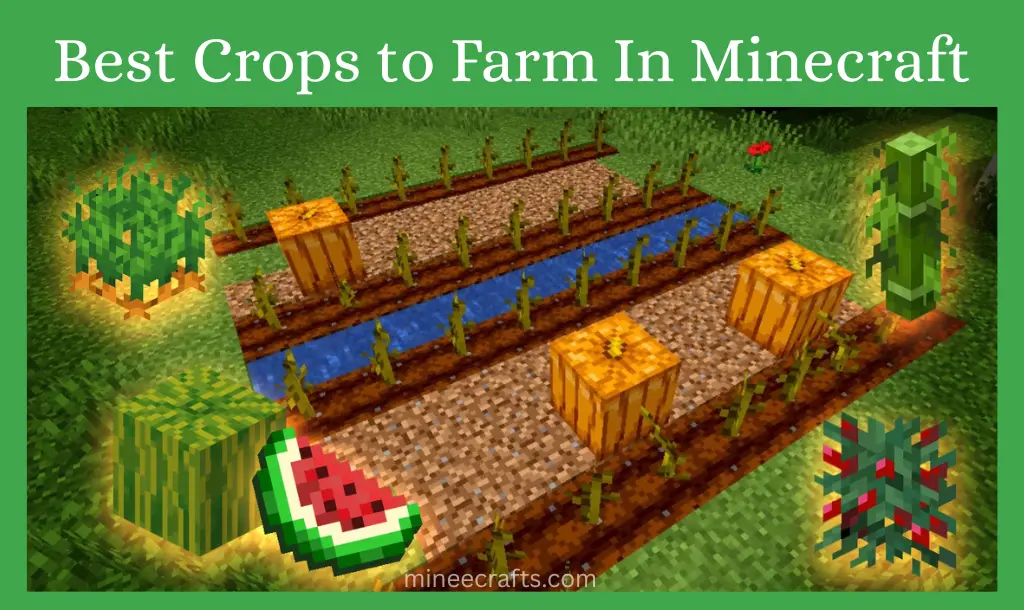
Players can grow a variety of crops for personal use or trade. Here are the main crops available in the latest versions:
|
Crop Name |
Seed Type |
Growth Time |
Uses |
|---|---|---|---|
|
Wheat |
Wheat Seeds |
~1–2 days |
Bread, Hay Bale, animal Breeding |
|
Carrots |
Carrot (itself) |
~1–2 days |
Food, Pig Breeding |
|
Potatoes |
Potato (itself) |
~1–2 days |
Food (after baking), pig breeding, and trading |
|
Beetroot |
Beetroot Seeds |
~1–2 days |
Food, beetroot soup, and dye. |
|
Pumpkins |
Pumpkin Seeds |
Vines grow, fruit grows later |
Pumpkin pie, pumpkin faces, Iron Golem creation, and decoration. |
|
Melons |
Melon Seeds |
Same as Pumpkin |
Food, Glistering Melon (for potions), trading |
|
Cocoa Beans |
Cocoa Beans (on jungle logs) |
Grows on jungle wood |
Cookies, Brown Dye |
|
Nether Wart |
Nether Wart (on Soul Sand) |
~4 stages (in Nether) |
Brewing potions |
|
Sugarcane |
Sugarcane |
Grow on Sand/Dirt near water |
Paper, sugar |
|
Bamboo |
Bamboo |
Grow on Dirt/Grass/Sand |
Fuel, scaffolding |
Steps to Grow Crops
Preparing Farmland
Growing crops in Minecraft begins with preparing the soil. Choose an open area close to your base. To create farmland, use a hoe on dirt or grass blocks. For the best results, keep the farm hydrated and expose it to enough sunlight or torches.
Planting Crops
You can plant your crop seeds into the soil once the farmland has been prepared. Plant the seeds for the crops you require. Make sure to place these seeds in the proper locations with adequate space between them. Protect your farm from mobs and animals.
Watering
To ensure proper growth, keep the crops hydrated by watering them on a regular basis. It is preferable to locate the water source four blocks away from the farmland so that the water can efficiently reach the farmland and hydrate it. Water hydrates farmland up to four blocks in all directions.
Light Requirements
Sunlight is extremely important for crop growth. Each crop grows at a different rate. So, to help them grow faster and better, keep them hydrated and give them enough light. Make sure your farm is located in an area with plenty of sunlight. Crops will fail if they do not receive enough light.
Harvesting Crops
When the farm and crops are ready, they can be harvested for personal use or trade purposes. You have the option to replant certain crops. Harvest the crops and store them for later use.
Methods of Crop Farming in Minecraft
Crop Farming Automation in Minecraft
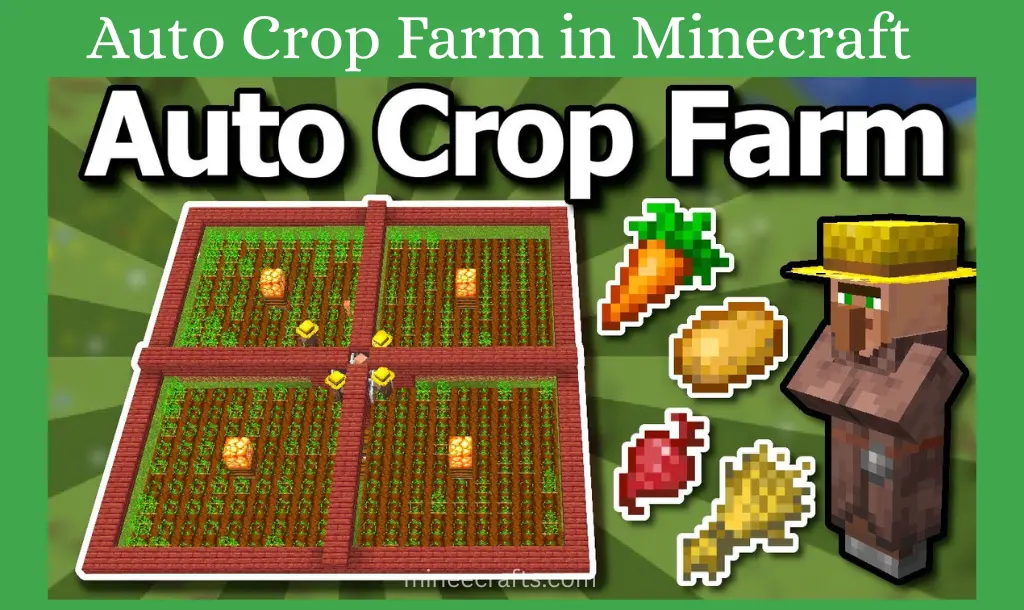
In Minecraft, automating farms is also known as AFK farms. There are two types of automatic farming: Redstone Automatic Farms and Villager-based Fully Automatic Farms.
Redstone Automatic Farm (Semi-Automatic)
This automated farm harvests crops using water and redstone. Crops must still be planted manually.
Required:
Process:
Step 1: Prepare the Field
- Establish a 9×9 farmland area.
- A water source should be placed in the center and covered with a slab or lily pad.
- To till the soil, use a hoe.
- To stop water from spilling, surround the field with blocks.
Step 2: Plant Your Crops
- Sow seeds in all farmland blocks.
Step 3: Install Dispensers
- Place the dispenser on one side of the field (or both sides for better reach).
- Fill the buckets with water.
Step 4: Redstone Mechanism
- Connect the dispensers containing Redstone dust.
- To trigger it, use a lever, button, or pressure plate.
Step 5: Collection System (Optional)
- To catch water flow, dig a trench at the end of the field.
- Place hoppers in the trench, leading to chests where you can collect items.
Step 6: Harvesting
- When you flip the lever or button, water flows and destroys all of the crops.
- Crops are pushed into the trench and stored in the chest.
Please note that this is a semi-automatic process that requires manual planting.
Villager-based Fully Automatic Farm
This setup uses Farmer Villagers to plant and harvest crops automatically; it is great for wheat, carrots, and potatoes.
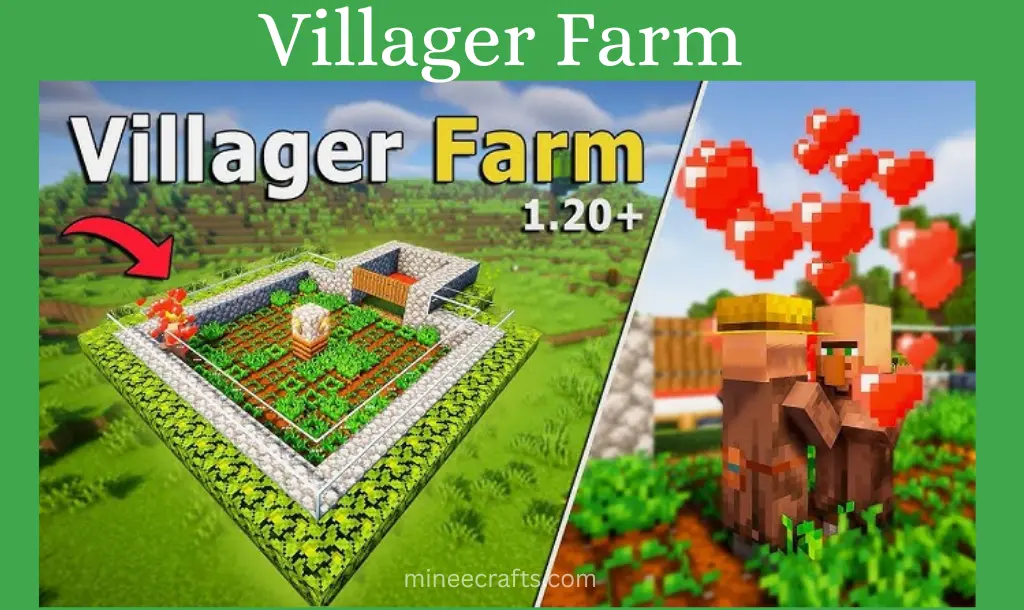
Required:
Process:
Step 1: Build a Farming Area
- Create a 9×9 field with a single water block in the center (covered with a slab).
- To keep the villagers inside, surround it with a fence.
Step 2: Assign the Farmer
- Place a composter around one villager.
- He’ll become a farmer villager.
- Automatically, he will begin planting and harvesting.
Step 3: Add the Second Villager
- Just outside the farm, but still visible to the farmer, put a second villager in a box.
- By throwing it, the farmer will attempt to provide the other villagers with food (crops).
Step 4: Collection System
- To collect dropped crops, place a hopper minecart or hopper underneath, rather than letting the second villager pick up the food.
- The hoppers should be redirected into the chest.
Best Farm Layouts in Minecraft
|
Layout Type |
Description |
|---|---|
|
9×9 Basic Farm |
Simple and efficient. 1 water block in the center and 80 farmland blocks around to hydrate the entire 9×9 area. |
|
Vertical Farm |
Design that saves space by stacking layers of farmland. |
|
Automatic Melon/Pumpkin |
Breaks the fruit automatically using observers and pistons. |
|
Tiered Hill Farm |
For aesthetically pleasing builds, layer on mountain slopes. |
|
Greenhouse Farm |
Aesthetic and functional. Glass roofs, torch lighting, and glass walls protect crops from mobs. |
💡 Pro Farming Tips
Common Farming Mistakes
📈 How to Increase Crop Growth Speed
- Plant different crops in rows.
- Stay near the farm (chunks must be loaded.)
- Increase random tick speed in creative worlds.
- Use bone meal for instant growth.
Final Thoughts
Crop farming in Minecraft is more than just growing food; it’s about sustainability, automation, and progress. In 2026, farming remains one of the most important survival mechanics, ranging from simple wheat farms to advanced villager-powered emerald systems.
When you master farming, you will never run out of food, emeralds, or trading power. Begin with a 9×9 farm and gradually upgrade to automated systems for greater efficiency.